


.png)
The gap between the merchandising strategy devised at headquarters and the complex reality of execution at the point of sale is the Achilles’ heel of many retail campaigns. How can you ensure that a promotional concept comes to life exactly as planned, while guaranteeing a measurable return on investment (ROI)?
During a recent webinar organized in collaboration with RECO and Nestlé, three industry experts analyzed a concrete and particularly instructive use case: in-store activation for the NESCAFÉ® Dolce Gusto®.
Around the (virtual) table:
- Josselin, Key Account Manager at Retail VR.
- Souhaila, Sales Development Manager for NESCAFÉ® Dolce Gusto® (Nestlé Group).
- Laurent, a representative of Reco (Topo Group), is an expert with 20 years of experience in measuring in-store performance through a network of 28,000 mystery shoppers.
This article outlines the three key stages of this success: virtual design, field deployment, and performance measurement.
1. Design: Moving from 2D planograms to virtual immersion with Retail VR
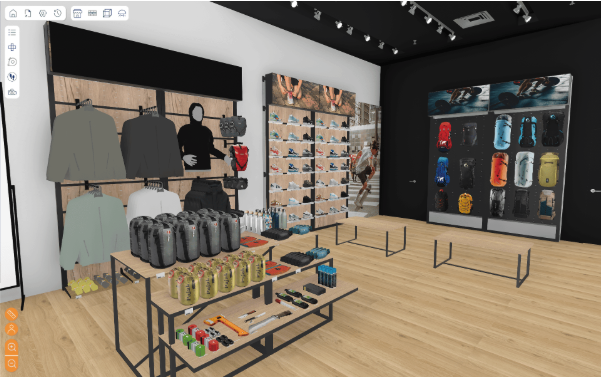
The first step in any successful sales campaign is its design. Historically, these were limited to simple spreadsheet-based merchandising plans in spreadsheets, brands can now rely on virtual reality and spatial modeling to bring their concepts to life even before they physically exist.
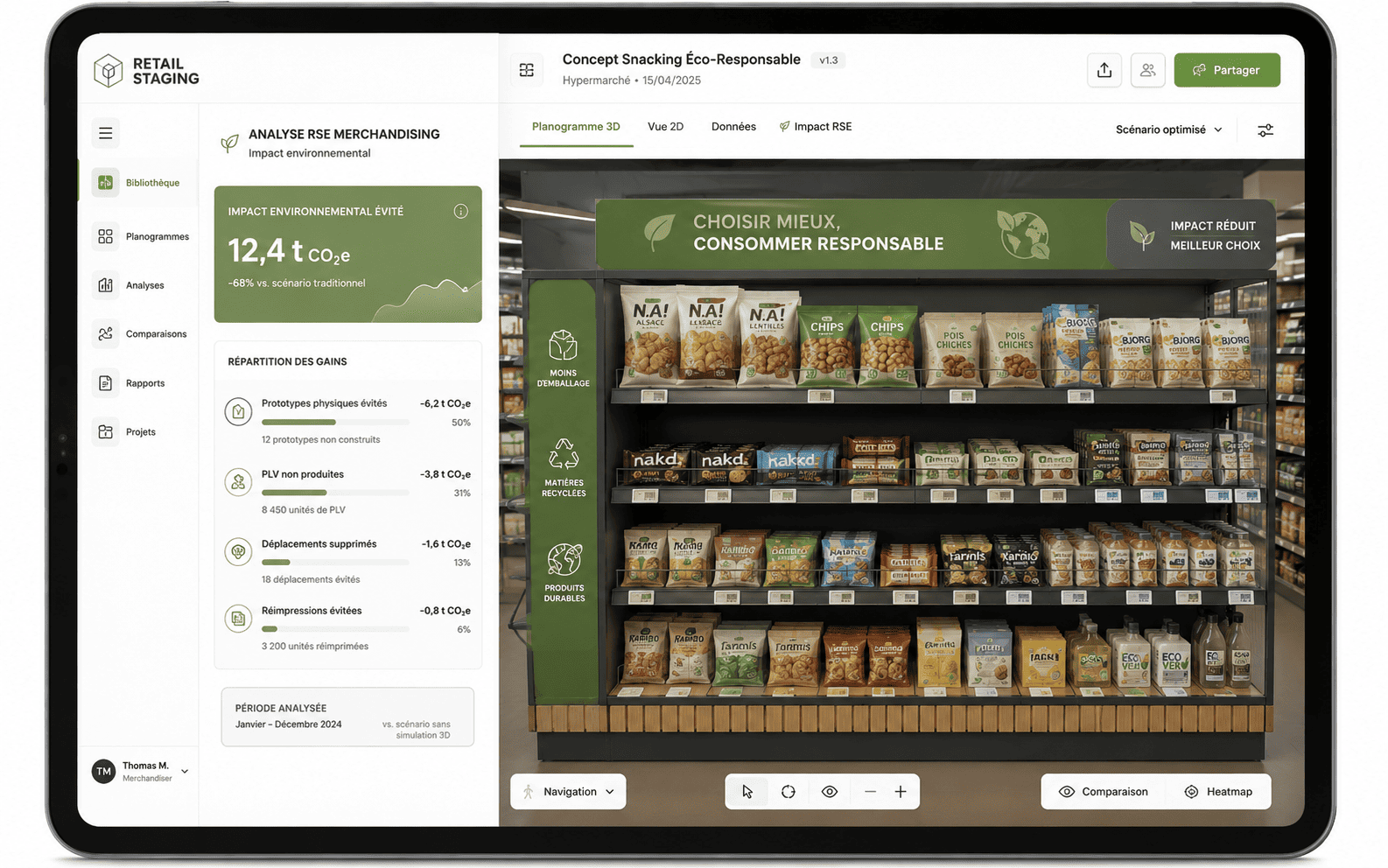
Our collaborative platform stands out for its ability to make the creation of immersive environments accessible to non-technical teams (catmen, sales representatives, trade marketers):
- Automated Generation: Using just a simple front-view image of the product and its dimensions, the platform lets you generate virtual versions of your products to create faithful digital replicas. The addition of this spatial dimension adds a crucial level of realism.
- Do-it-yourself design : Thanks to an integrated virtual library, users can select their products and POS (Point-of-Sale) materials with a simple "drag-and-drop" to build their shelf or endcap display.
- Immersive "Shopper" Simulation: This tool allows you to place the device in a realistic retail environment (aisle, dedicated section). This enables teams to validate the strategy by literally putting themselves in the consumer’s shoes.
- Sales Support: Once the display has been modeled, it becomes a powerful sales tool for key national accounts. Visualizing the final project makes it easier to gain the support of major retailers (Carrefour, Auchan, Leclerc) when negotiating strategic placements.

2. Rollout: Train the sales force and maximize buy-in
For NESCAFÉ® Dolce Gusto®, a Nestlé client for 15 years, in-person activations are critical, particularly for the sale of their machines. The focus of this webinar was a large-scale campaign: the launch of the new "Neo" system, supported by nearly 4,000 promotional events scheduled during the crucial end-of-year period (October through December).
Souhaila emphasized how the Neo system (a closed system requiring extensive consumer education) demanded flawless execution. The immersive simulation proved to be a major operational driver for the rollout:
- Enhanced Training for Event Staff: In partnership with the Top Selling agency, the brand has incorporated virtual renderings into its e-learning modules and in-person training sessions. Event staff no longer simply read a technical brief; they can now visualize the exact layout of their booth, which helps them understand the brand’s identity more quickly.
- Experience Design: In addition to the visual elements, the training emphasizes the key steps: testing the machine, offering coffee tastings, and mastering the sales pitch, which will serve as the primary sales driver.
- Simplifying Setup: On the day of installation, field teams (and department managers) know exactly where and how to set up the in-store display. The interactive visuals serve as a guide for adjusting the setup based on the store type (supermarket vs. hypermarket).
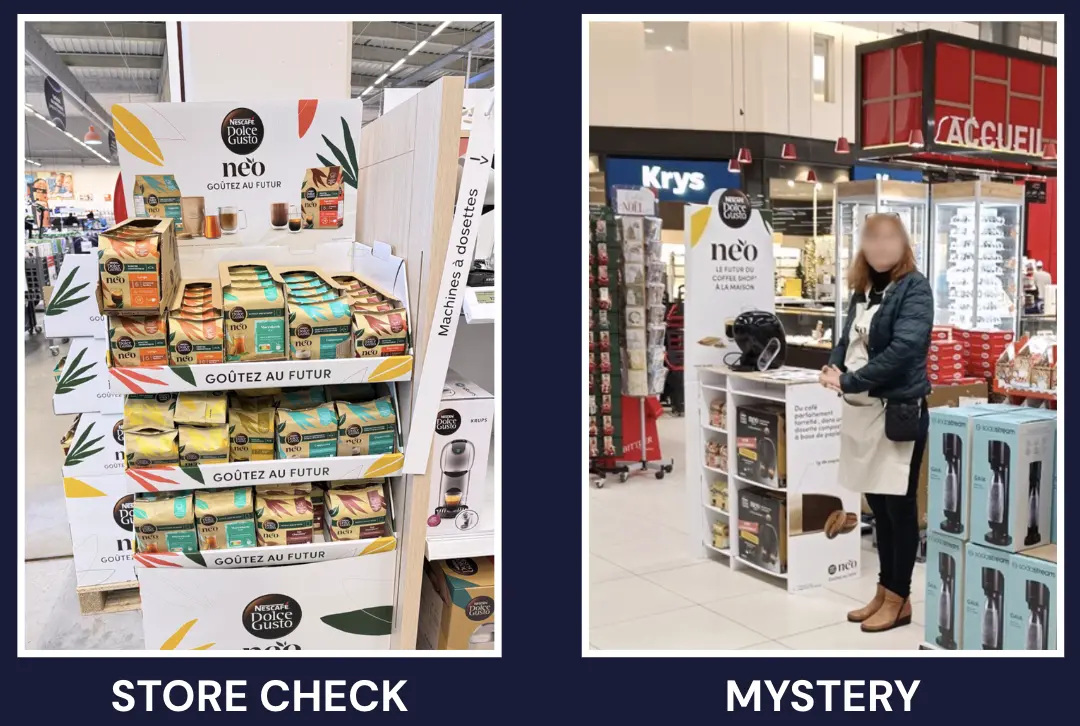
3. Measurement: Comparing the virtual model with the physical reality using Reco
Once the activation has been rolled out, it is necessary to measure its effectiveness and identify any pain points. Laurent (Reco) provided details on the audit conducted on a sample of 500 stores targeted by the Neo campaign.
The audit consisted of two parts:
- "Store Check": Verification that the store layout complies with the initial merchandising plan.
- "Mystery Shopping": Qualitative assessment of in-store activities under real-world conditions.
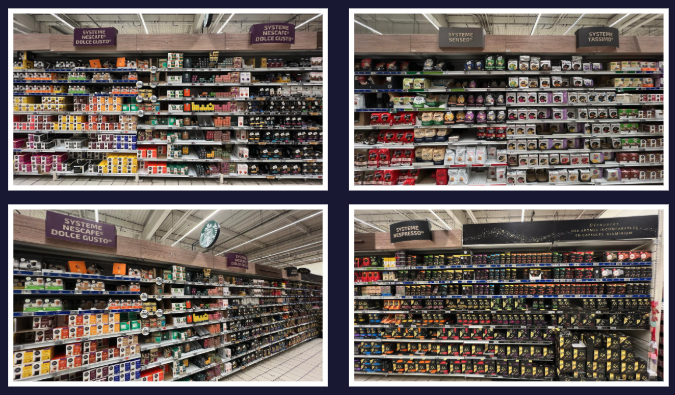
Business results that significantly outperform the competition
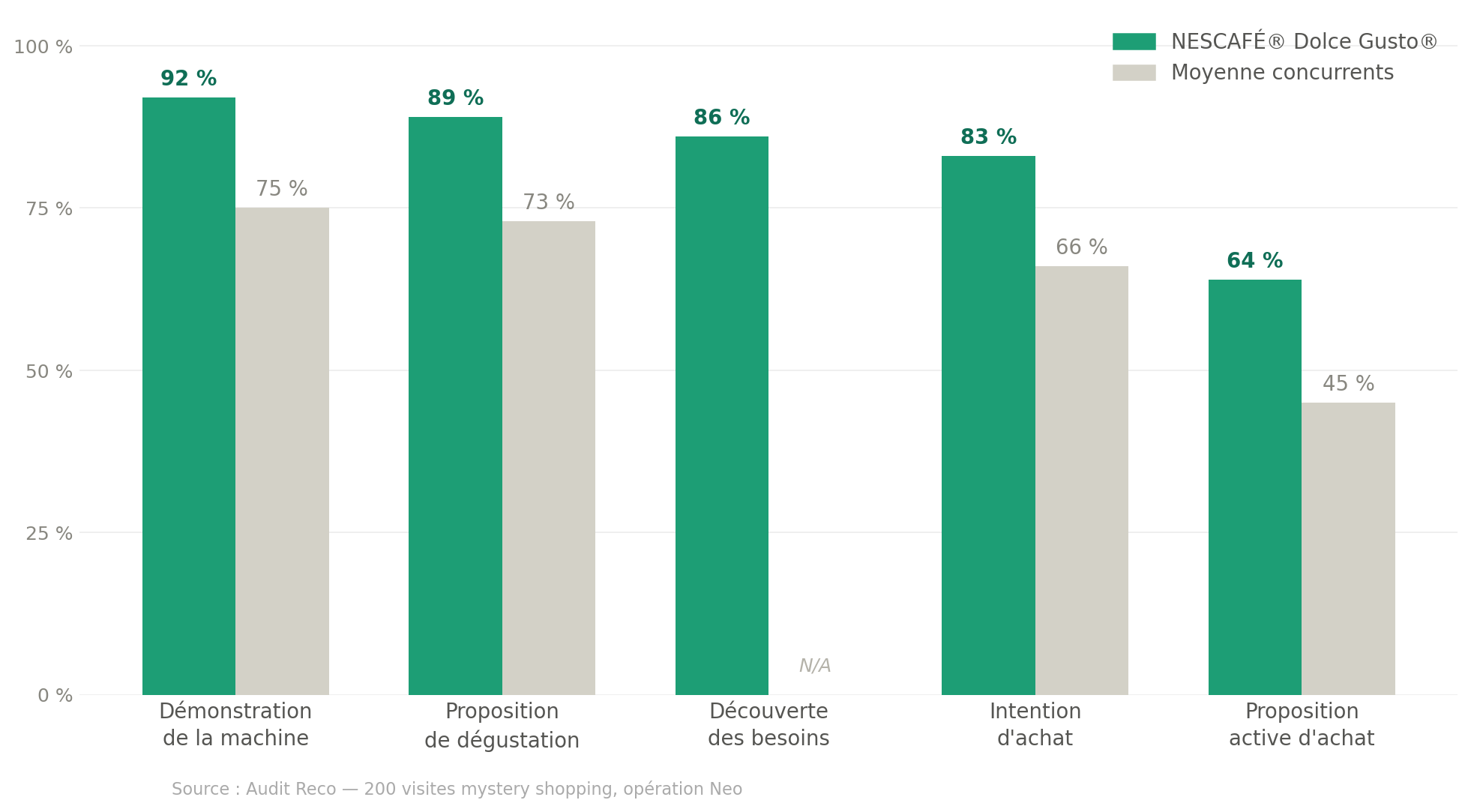
The data collected by Reco’s mystery shoppers (including 200 visits dedicated to the Neo promotion) confirmed the excellence of the NESCAFÉ® Dolce Gusto® rollout, with KPIs that significantly outperform the market average:
Criteria for evaluating the presentation
Identify performance gaps to improve
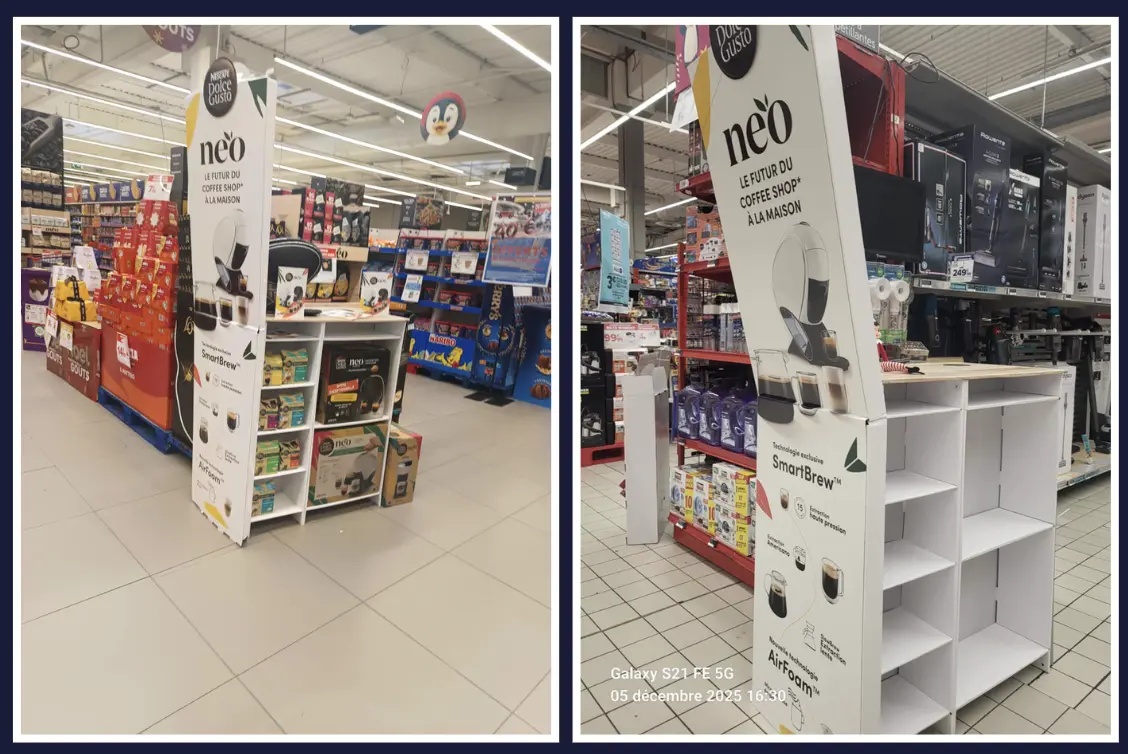
An audit isn't just about celebrating successes; it helps identify areas of friction (the famous "gap" between the virtual and the real). The on-site analysis revealed issues that were invisible in an idealized virtual model:
- Logistical challenges: Some displays are sometimes placed in regular aisles instead of the planned promotional center aisle, requiring a redesign of the display formats.
- Visually jarring details: Exposed electrical cables or cables lying on the floor, which detract from the stand’s “premium” aesthetic.
- Material wear and tear: Cardboard point-of-sale displays damaged by heavy foot traffic, indicating that sturdier materials are needed for operations lasting several weeks.
Key takeaways from this case study
The combination of 3D virtualization (Retail VR) and on-site measurement (Reco) creates a virtuous cycle for brands like NESCAFÉ® Dolce Gusto®:
- Forecasting: Immersive modeling helps resolve congestion issues and win over distributors early on.
- Implementation: A sales team that "visualizes" its environment before arriving at the store is more self-reliant and effective.
- Ongoing adjustments: The field audit allows us to make adjustments during the campaign (e.g., reminding staff about dress codes or cable layout) and to use this feedback to improve the design of future point-of-purchase displays modeled the following year.

.webp)
.webp)
.webp)

