


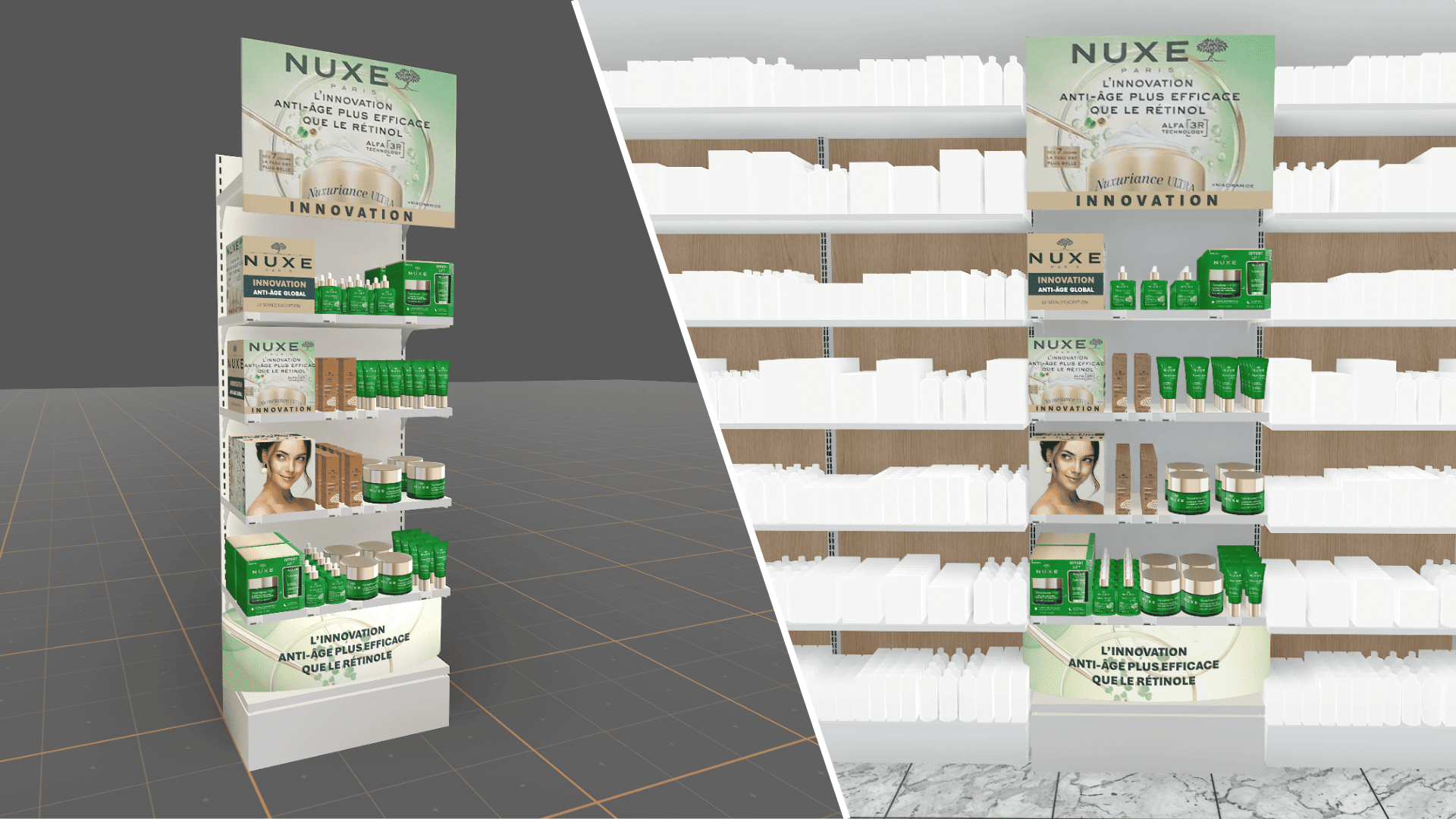
Key takeaways:
- Background: The pharmacy and drugstore (GMS) sector is booming, driven by dermo-cosmetics, "clean beauty," and dietary supplements.
- The problem: The physical space available in pharmacies and drugstore aisles is not expandable. The oversaturation of the market forces retailers to manage their shelf space with one overriding goal: profitability per square centimeter.
- The Category Challenge: Introducing a new product line requires reorganizing the product assortment and convincing the pharmacist or buyer that this new product will generate higher revenue (sales per linear meter) without disrupting the clarity of the category.
- The solution: Companies in the health and beauty industries are adopting 3D space planning tools and digital twins to virtually model store aisles. This allows them to test the impact of their merchandising recommendations through immersive shopper studies before any rollout.
The health, wellness, and dermo-cosmetics market is experiencing exceptional growth. Consumers, seeking natural products, scientific reassurance, and preventive care, are turning in droves to specialty retailers: pharmacies, drugstores, and the health sections of large retail stores (GMS).
In response to this craze, product launches are multiplying. “Clean beauty,” nutricosmetics, targeted dietary supplements… The selection is overwhelming. Yet for cosmetics laboratories and brands, a physical barrier stands in the way: the walls of pharmacies and stores cannot be expanded.
In this environment, where shelf space is saturated and highly regulated, introducing a new product line or reorganizing a category becomes a balancing act for the Category Manager. How can you prove that your merchandising recommendation will maximize shelf performance? Today, the answer lies in foresight and 3D simulation.
Oversaturation: The Challenge Facing Health and Beauty Shelves
Unlike a traditional hypermarket, where aisles can be several dozen meters long, the space in a pharmacy or health and beauty section is often cramped. The shelves are packed tightly together, and ceiling heights are sometimes limited.
In this context, the pharmacy owner or health products department manager has one key performance indicator: profitability per square centimeter (or sales per linear meter). Every facing (the visible part of the product display) allocated to a brand must be justified by rapid turnover and high added value.
According to IQVIA’s regular data on the pharmaceutical and over-the-counter markets, competition among pharmaceutical companies to secure shelf space has never been fiercer. To launch a new dermo-cosmetic product, the CatMan often has to propose “discontinuing” an existing product.
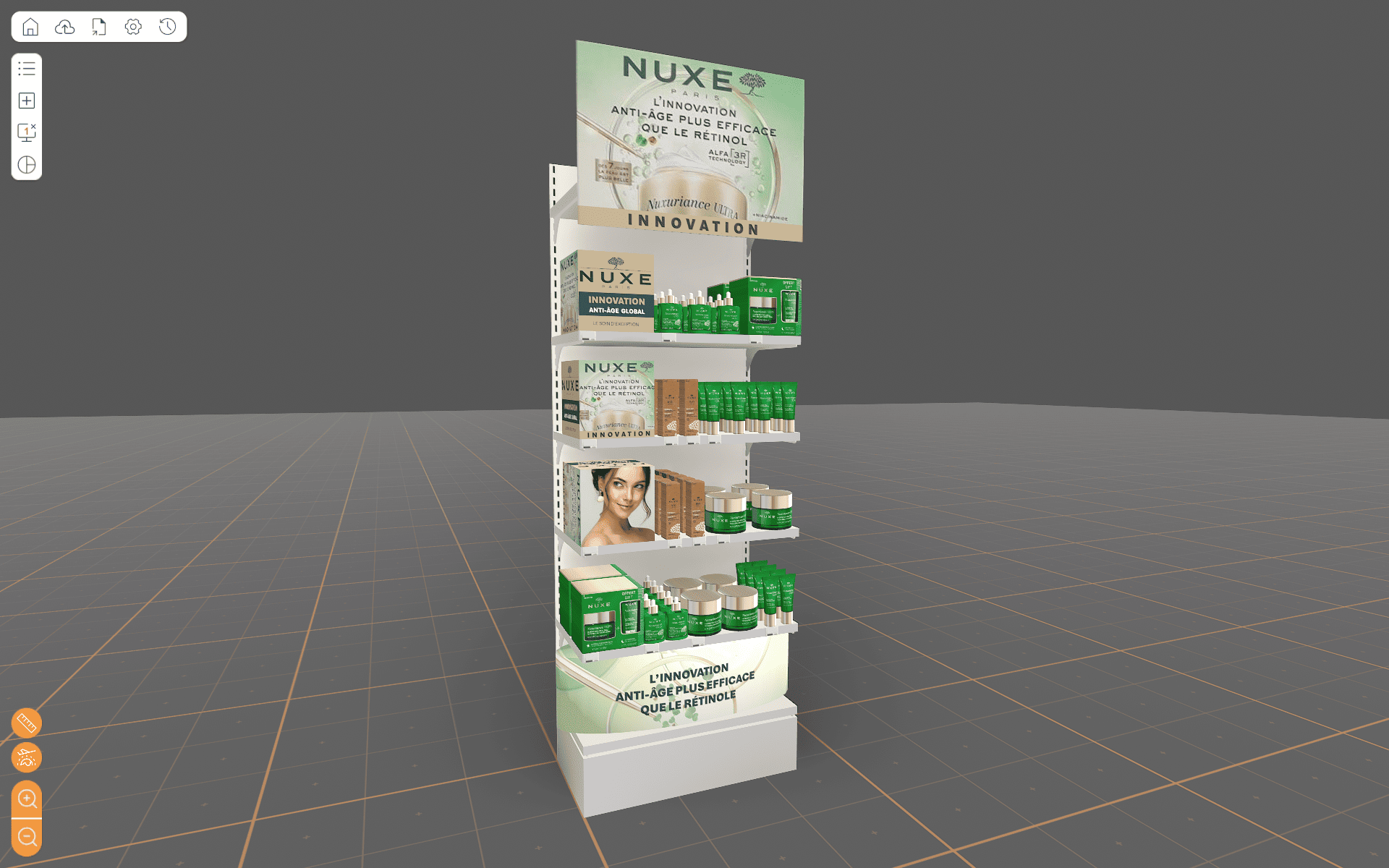
The Limitations of Traditional 2D Planograms
Until now, pharmaceutical companies have used 2D planograms and Excel spreadsheets showing theoretical profitability to convince pharmacists to change their shelf layouts. But these tools are now showing their limitations:
- They do not convey the visual clutter caused by packaging that is sometimes very similar (the well-known, very clinical color codes: white, blue, green).
- They do not allow for an assessment of the "clarity" of the segmentation (e.g., clearly distinguishing moisturizing products from anti-aging products).
- They are struggling to reassure customers about the actual space taken up by display fixtures (shelf extensions, end caps, and display stands), which are vital in drugstores for guiding customer choices but which take up valuable product space.
Merchandising with 3D and AI: The Precision Tool for Optimization
To bridge the gap between mathematical theory and visual and behavioral evidence, health and beauty companies are incorporating 3D merchandising technologies. The approach is becoming surgical.
1. Millimeter-precise visualization of actual volumes
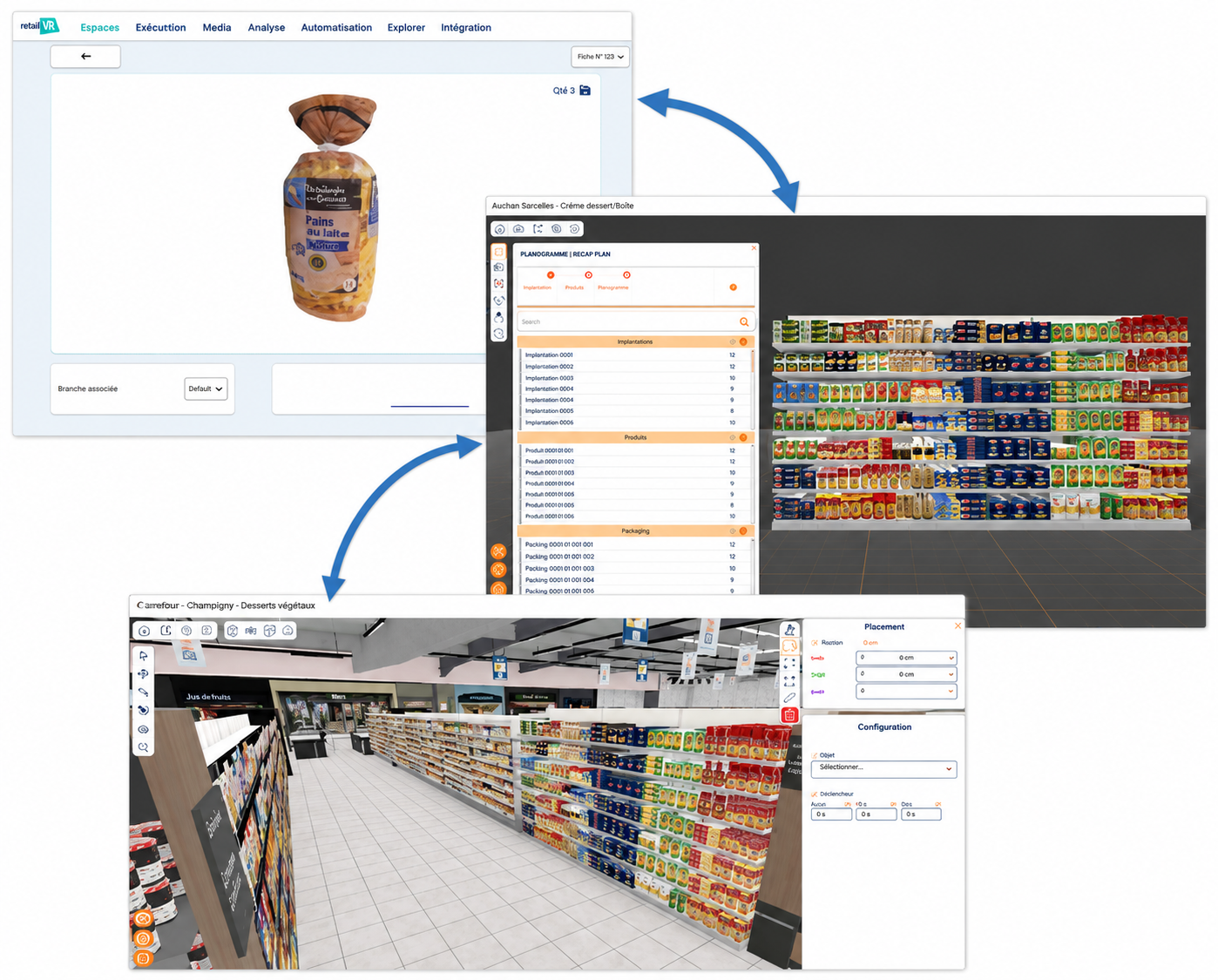
Creating a Digital Twin of the health and beauty aisle allows you to import the exact CAD/3D files of your packaging. No more unpleasant surprises during store layout: you can immediately verify whether the new size of your pump bottle fits perfectly between two shelves, while leaving enough space for customers to pick up the product. This level of precision instantly reassures the buyer about the operational feasibility.
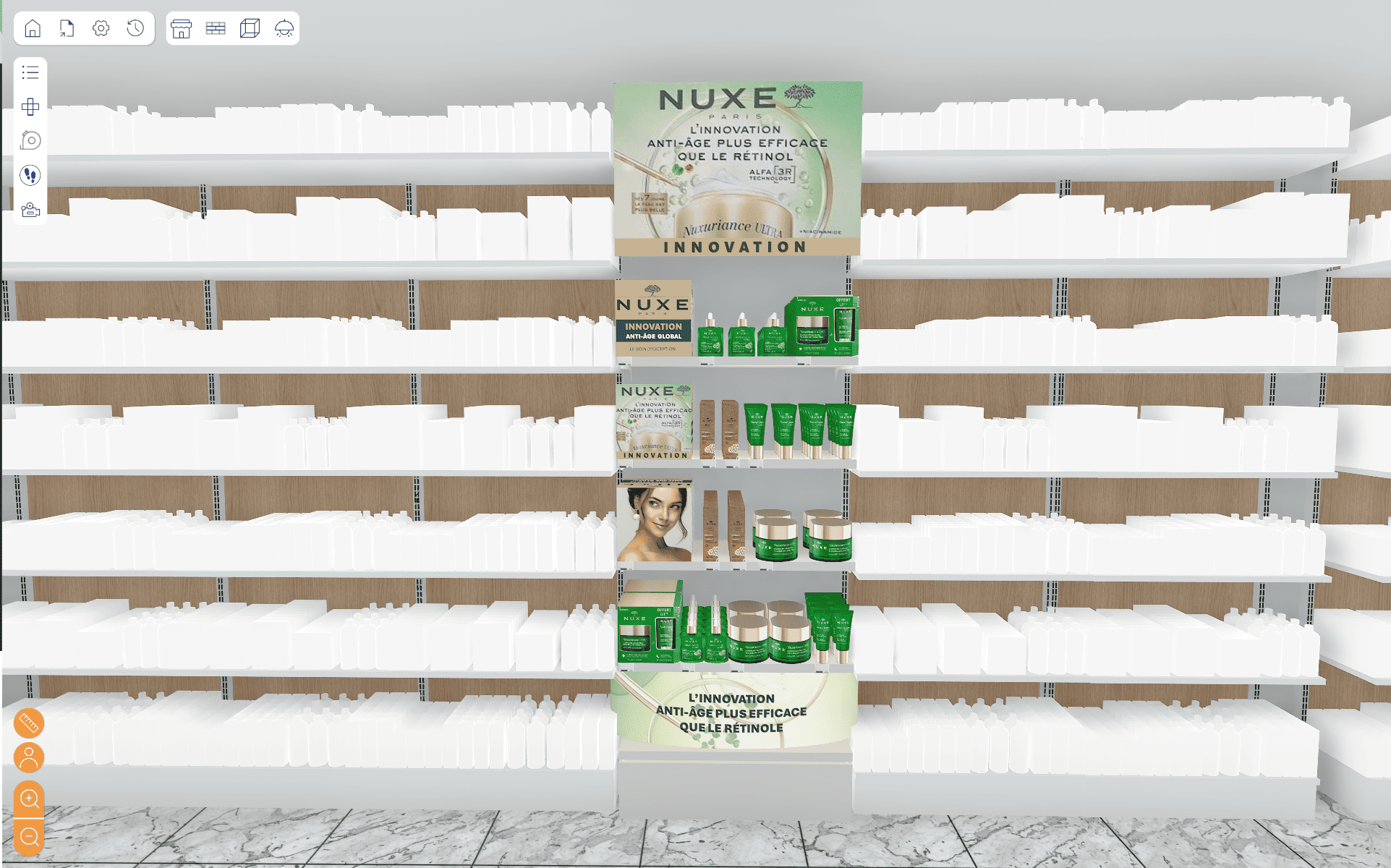
2. Shopper Research: Verify the clarity of the offering
How can you tell if your new "Patient Benefit" segmentation (e.g., Atopic-Prone Skin vs. Combination Skin) is actually understood by customers? Rather than risking a drop in sales by testing it "live" in pharmacies, pharmaceutical companies conduct A/B tests in virtual stores.
By equipping a group of consumers with virtual reality headsets that include eye-tracking technology, we can observe which areas of the shelf capture their attention (hot spots) and which are ignored. This allows us to scientifically validate that the new in-store advertising (ISA) actually helps drive conversions.
3. The Sales Pitch in Mixed Reality
Selling a merchandising concept to a pharmacy group or a distributor is becoming an immersive experience. Instead of printing a static merchandising brochure, the pharmaceutical representative or KAM (Key Account Manager) uses a tablet or a mixed reality headset to project the new shelf layout in 3D, at a 1:1 scale, directly into the client’s office or pharmacy. The pharmacist “experiences” the shelf layout and approves the layout much more quickly.
Conclusion: Space is limited, but value is not
In the health and beauty sector, the battle for shelf space is no longer won simply by asking for more space. It is won by demonstrating a superior ability to optimize existing space.
The use of 3D simulation and immersive shopper studies enables brands and pharmaceutical companies to take on the role of “expert advisor” (Category Captain) to pharmacists. By demonstrating—both visually and through data—that your planogram maximizes profitability per square centimeter, you can ensure the success of your product launches and streamline your consumers’ health and beauty journey.
Ready to maximize the profitability of your health and beauty product displays?
Discover how Retail VR helps leaders in the dermo-cosmetics industry digitize their merchandising. Create 3D models of your shelves and demonstrate the value of your concepts at your next meeting.


.webp)
.webp)
.webp)

